sabato 13 ottobre 2012
mercoledì 10 ottobre 2012
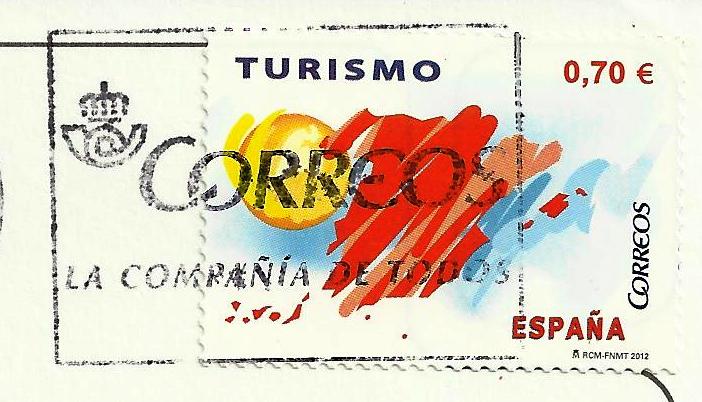
393 - Postcard from Granada Spain (Thanks Anna)
Granada - Patio de Los Leones
The Court of the Lions (Spanish: Patio de los Leones - Arabic: بهو السباع) is the main
court of the Nasrid dynasty Palace of the Lions, in the heart of the Alhambra, the Moorish citadel formed by a complex of palaces, gardens and forts in Granada, Spain.
It was commissioned by the Nasrid sultan Muhammed V of the Emirate of Granada in Al-Andalus. Its construction started in the second period of his reign, between 1362 and 1391 AD. The site is now
part of the UNESCO World Heritage List and minted in Spain's 2011 limited edition of 2 € Commemorative Coins.
Etichette:
Postcard,
Spain,
Stamp,
Unesco Wolrd Heritage
391 -Postcard from India (Thanks Seetharaman)
TAJ MAHAL
The Taj Mahal is a white marble mausoleum located in Agra, Uttar Pradesh, India. It was built by Mughal emperor Shah Jahan in memory of his third wife, Mumtaz Mahal.
The Taj Mahal is widely recognized as "the jewel of Muslim art in India and one of the universally admired masterpieces of the world's heritage".
Taj Mahal is regarded by many as the finest example of Mughal architecture, a style that combines elements from Persian, Ottoman Turkish and Indian architectural styles.
In 1983, the Taj Mahal became a UNESCO World Heritage Site. While the white domed marble mausoleum is the most familiar component of the Taj Mahal, it is actually an
integrated complex of structures. The construction began around 1632 and was completed around 1653, employing thousands of artisans and craftsmen.
The construction of the Taj Mahal was entrusted to a board of architects under imperial supervision, including Abd ul-Karim Ma'mur Khan, Makramat Khan, and Ustad Ahmad Lahauri.
Lahauri is generally considered to be the principal designer.
The Taj Mahal is widely recognized as "the jewel of Muslim art in India and one of the universally admired masterpieces of the world's heritage".
Taj Mahal is regarded by many as the finest example of Mughal architecture, a style that combines elements from Persian, Ottoman Turkish and Indian architectural styles.
In 1983, the Taj Mahal became a UNESCO World Heritage Site. While the white domed marble mausoleum is the most familiar component of the Taj Mahal, it is actually an
integrated complex of structures. The construction began around 1632 and was completed around 1653, employing thousands of artisans and craftsmen.
The construction of the Taj Mahal was entrusted to a board of architects under imperial supervision, including Abd ul-Karim Ma'mur Khan, Makramat Khan, and Ustad Ahmad Lahauri.
Lahauri is generally considered to be the principal designer.
Etichette:
India,
Postcard,
Stamp,
Unesco Wolrd Heritage
domenica 7 ottobre 2012
389 - Postcard from Usa (Thanks Cyra)
Chesapeake Bay Blue Crab
Tha bay has an abundance of these delicious crabs.
Steament with spices, the crabs are shelled and eaten
plain or made into, soup, crab cake, or crabe imperial.
Soft-shelled crabs are caught during molting season,
when they shed their hard shell.
giovedì 4 ottobre 2012
domenica 30 settembre 2012
385 - Postcarf from Utrecht Netherlands (Thanks Janny)
Utrecht city and municipality is the capital and most populous city of the Dutch province of Utrecht. It is located in the eastern corner of the Randstad conurbation, and is the fourth largest city of the Netherlands with a population of 316,448 on 1 February 2012.
Utrecht's ancient city centre features many buildings and structures from the Early Middle Ages. It has been the religious centre of the Netherlands since the eighth century. Currently it is the see of the Archbishop of Utrecht, the most important Dutch Roman Catholic leader. Utrecht is also the see of the archbishop of the Old Catholic church, titular head of the Union of Utrecht (Old Catholic), and the location of the offices of the main Protestant church. Until the Dutch Golden Age Utrecht was the city of most importance of the Netherlands until Amsterdam became its cultural
and most populous centre.
Utrecht is host to Utrecht University, the largest university of the Netherlands, as well as several other institutes for higher education. Due to its central position within the country, it is an important transport hub for both rail and road transport. It has the second highest number of cultural events in the Netherlands, after Amsterdam.
Iscriviti a:
Post (Atom)